In shortOn 10 November 2026, at ToruńCAMERIMAGE, Artur Paprocki showed how Veles Productions uses AI on set. Synapse Stage™ is an LED virtual production stage in Warsaw. The wall lights the actor's face, and AI changes only the world, costume and hair around them. The face and the performance always come from the original take.
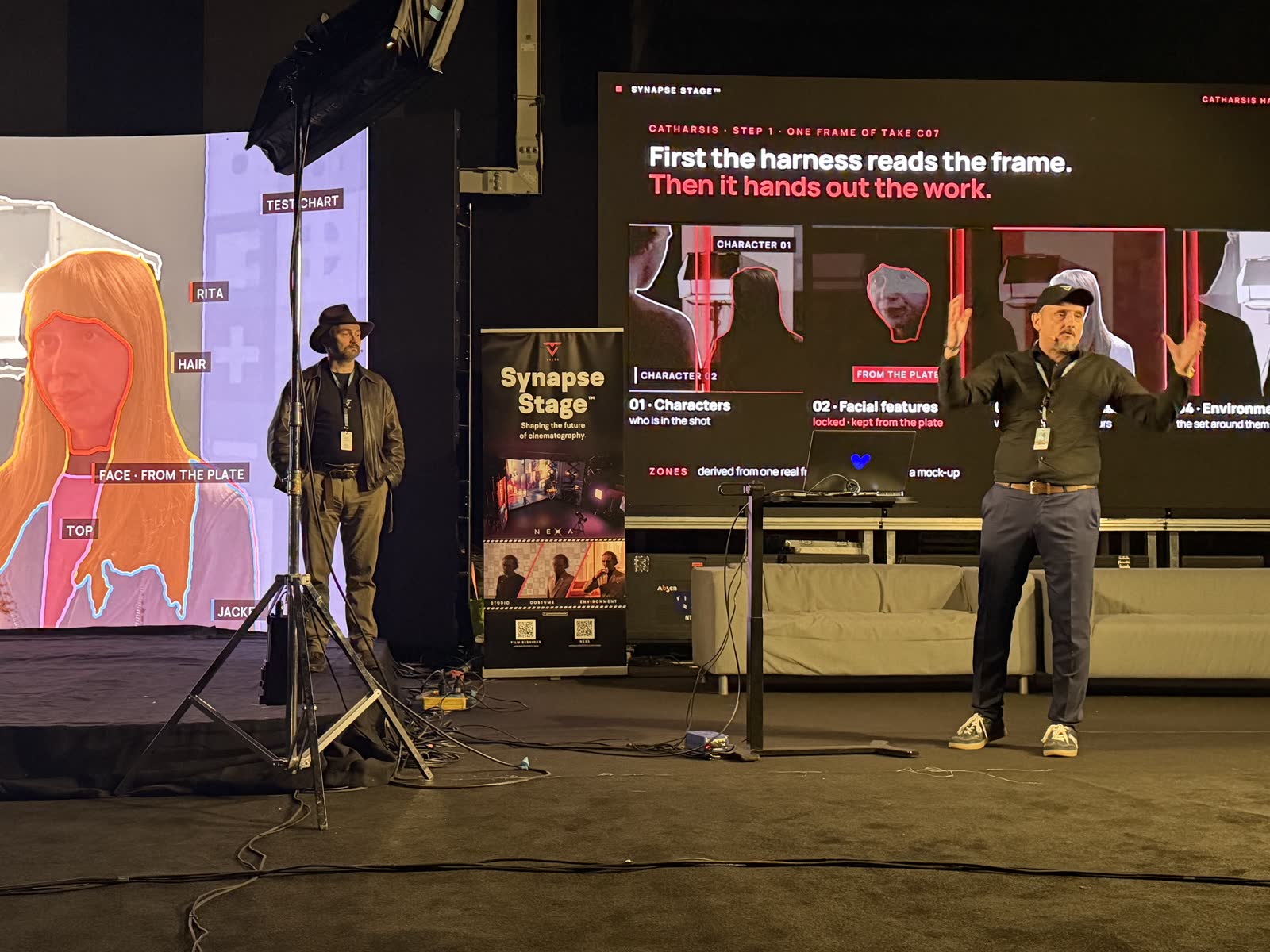
Synapse Stage talk, ECFC Studio, ToruńCAMERIMAGE, 10 November 2026. Left wall: one frame split into layers. The face stays from the plate.
01 · Where AI really is
Why talk about AI on set now?
Because AI has spread fast but shallow.
Generative AI reached about 40% of US adults in two years. The internet took five years, the personal computer twelve (St. Louis Fed, Bick, Blandin and Deming, September 2024). Most people still use it as a chat window. We asked the room which of five levels they work at today:
Prompt
Chat
Agent
Multi-agent
Agent crew on set
Level 5 on Synapse Stage: an AI gaffer, an LED technician and the camera, working as one crew.
02 · How Synapse Stage works
What is Synapse Stage?
Synapse Stage™ is Veles Productions' LED virtual production stage in Warsaw.
The LED wall shows the world of the scene and, at the same time, lights the actors. AI then changes what surrounds the actor (the set, the costume, the hair), while the face and the performance stay exactly as shot.
Does AI change the actor's face or performance?
No. The face always comes from the original take, the plate, and goes through no AI model.
That matters for consent and for awards. The Academy's rules for the 99th Oscars (published 1 May 2026) require acting roles to be "demonstrably performed by humans with their consent". SAG-AFTRA allows wardrobe, make-up and added effects without extra consent as long as the performance stays as recorded.
As shotFace · from the plate
CostumeWorld
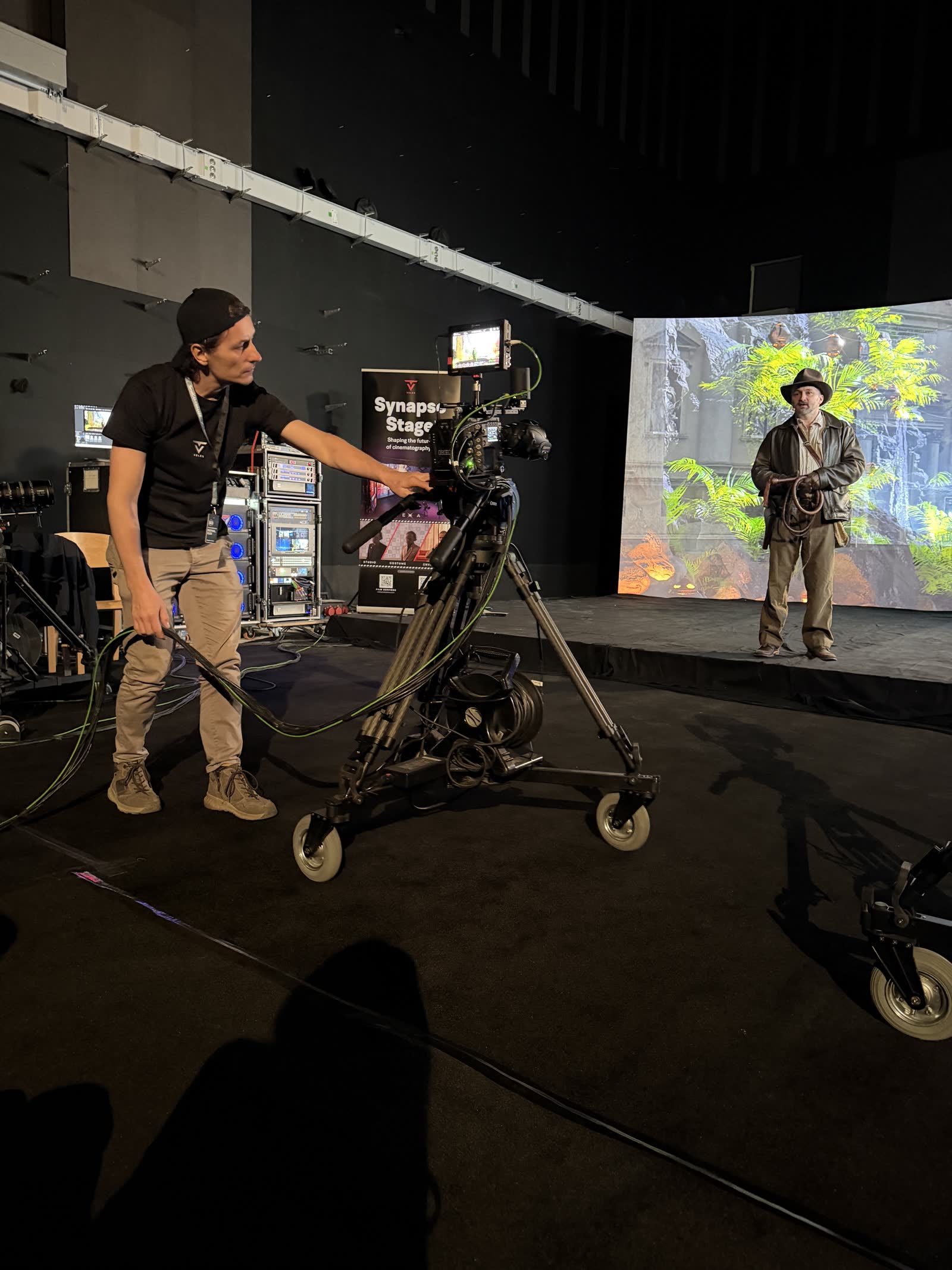
One take of Luis from NEXA. Pick a costume or a world: AI changes everything around him, and the face and the performance stay as shot in every version.
Face and light stay in the physical world. Everything else is free to move.
Why light the actor with the LED wall, not just use it as a background?
Because real light on a face can't be faked convincingly in post.
On Synapse Stage the wall is the key light. The direction of the light is fixed in the script, built into the set, then reproduced on the stage. Change the world on the wall and the colour and direction of light on the actor change with it, in camera.
01 · Plan
02 · Set
03 · Stage
From the script to the stage: one light direction, fixed on the plan, built into the set, lit by the wall.
At the talk we showed an AI gaffer live: the director or DoP says one sentence and the AI relights the wall.
One sentence, new light. The wall and the light on the face change together.
How does AI change the frame without touching the face?
Our Catharsis harness splits every frame into layers and locks the face.
The layers are environment, characters, costume and hair, and the face. Each layer goes to the model that suits it: Veles local models, or public ones such as Nano Banana Pro, GPT Image, FLUX, Seedream, Veo, Kling, Seedance or Ray3. Masking runs on our local models. The face is copied from the plate.
First the harness reads the frame. Then it hands out the work, to local or public models. The face goes to none.
Step 1 · masksFace · from the plate
The harness at work on one frame of take C07: a mask for each layer, made on our local models.
↔
As shot · plateFinal · AI costume + world
Drag the line. Left: one dialogue cut as shot, on the plate. Right: the same frames after the harness, with new costumes and a new world. The faces don't change.
What is Ghost Frame?
Ghost Frame lets one LED wall show several images in turn, faster than the eye can see.
It's a technology from Megapixel VR, ROE Visual and AGS. We use three images: A is light only, B is markers and data for the model, C is the world the camera records.
A and B are real Ghost Frame images from Synapse Stage; C is drawn. Slowed down so you can see it. On set the wall switches faster than the eye can follow.
03 · Who learns from whom
Do AI video platforms train on my footage?
Some do, by default. Read the terms before you upload.
We read the main platforms' terms on 10 November 2026. Higgsfield trains on users' content by default; only Enterprise can opt out. Dreamina takes a perpetual, irrevocable licence "for any purpose". Higgsfield, Kling and Luma forbid training models on their outputs; Runway forbids it for similar or competing products. So they can learn from your film, and you may not learn from theirs. We still use these tools, like everyone else. We just don't upload what we want to own.
Every upload teaches someone else.
What does "the film ships with its model" mean?
After the shoot, a model of the film is trained on the film's own records and sold together with the film.
Pre-production happens in StoryVerse and the shoot on Synapse Stage. Then the film's model is built from what the production recorded: light plans, takes, decisions. The know-how stays in the model and the rights stay with the creators. Make a film with us and you keep the model, the rights and the know-how. Our own model is called Catharsis.
04 · How to start on Monday
How can a filmmaker start with private AI?
On your own computer, in one evening, with one prompt.
Our free four-page guide covers it: a terminal agent (Claude Code, Gemini CLI, Codex or OpenCode), project notes in Obsidian, a folder structure for a film, and five prompts to try, from script breakdown to shoot records.
Learn to build your own private AI. Start on Monday.
NEXA at ToruńCAMERIMAGE. The next evening, 11 November, we presented NEXA in the panel “Veles Productions: NEXA. Shaping the Future”, with Ola Panisko, Dorota Zwierzchowska and Kamil Pohl. More: velesproductions.com/nexa